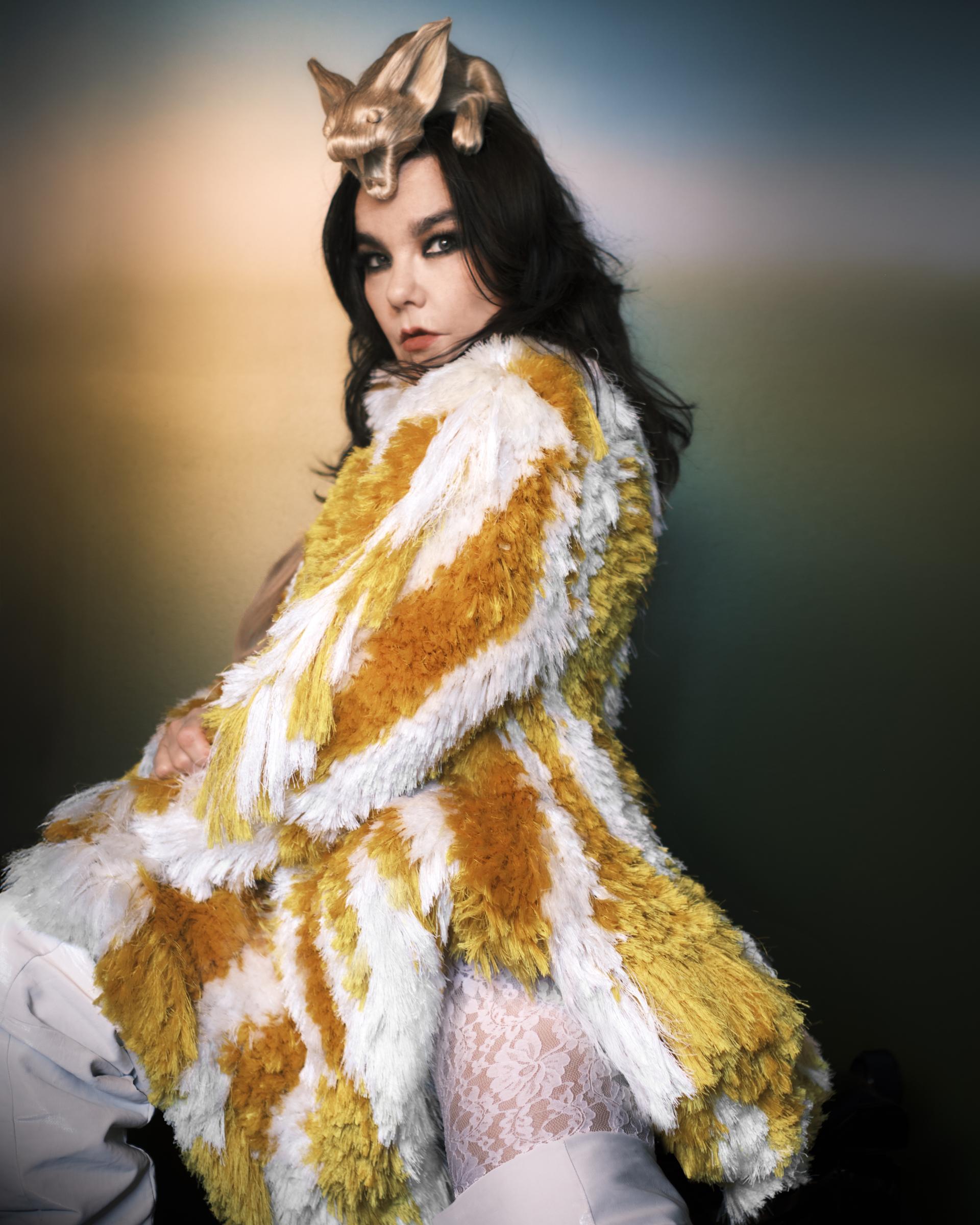
The National Gallery of Iceland today announces a major new exhibition by Björk, the internationally acclaimed musician, artist and innovator whose work continues to redefine the intersections of sound, nature, technology, fashion and contemporary art.
Opening in Reykjavík on 30 May 2026, the exhibition brings together three large-scale audiovisual installations, including two deeply personal works written in memory of Björk’s mother, alongside a newly commissioned film and sound installation developed from material connected to her forthcoming musical work. The exhibition premieres with Björk appearing in a look by Bottega Veneta, who joined the project as patron of Nerve Bloom and partner of the exhibition, helping the realisation of the work as part of an ongoing dialogue between fashion, moving image and experimental performance. At the centre of the exhibition are Ancestress and Sorrowful Soil, originally released during Björk’s acclaimed Fossora era and now reimagined on a theatrical scale within a museum context for the first time.
Set within a remote Icelandic valley, Ancestress unfolds as a ritualistic meditation on ancestry, grief and renewal, merging cinematic landscape with choral procession and movement. Sorrowful Soil is presented as an immersive nine-part choral sound installation, featuring thirty individual speaker channels transmitting voices from the Hamrahlíð Choir under the direction of Þorgerður Ingólfsdóttir. Developed in partnership with Genelec, the work transforms the gallery into a spatial listening environment where voice, resonance and architecture become inseparable.
Genelec supports the exhibition by providing the sound system that enables the works to be experienced as spatial compositions. The collaboration focuses on how accurate and neutral sound reproduction can support the artistic vision, allowing each piece to unfold naturally within the space and connect with the audience. Alongside these works, visitors will encounter a newly created installation drawn from Björk’s forthcoming body of work, offering an early glimpse into her next creative chapter through sound, film and immersive technology.
The exhibition is further supported through creative and technical collaborations with Apple, who join as VR partner, and AIAIAI, who provide headphone technology throughout the exhibition experience. Additional partnerships will be announced in due course. Presented concurrently in Gallery 4 is Metamorphlings, a companion exhibition by James Merry, Björk’s longtime visual collaborator and co-creative director, exploring sculpture, transformation and hand-crafted organic forms.
Alongside the exhibition, Björk will also present Echolalia, a one-day solar eclipse rave taking place on Wednesday 12 August 2026 at Víðistaðatún in Hafnarfjörður, Iceland. Coinciding with a rare solar eclipse, the event will culminate in one minute and four seconds of totality, during which the moon completely obscures the sun and Iceland is briefly submerged in darkness. The gathering will feature a DJ set from Björk alongside performances from Arca, Sideproject and Ronja, while also celebrating the 40th anniversary of the influential Icelandic collective and label Smekkleysa.
Festival passes will include access to the Echolalia exhibition at the National Gallery of Iceland, alongside limited collector’s edition merchandise and publication packages. Further information surrounding Echolalia, the eclipse event and Björk’s forthcoming new work will be announced soon. Talking about the new work Björk said: “Avatars, animation and archetypes: Nerve Bloom (remix), I wanted to tell you how we made the visuals for nerve-bloom.
“I did it with Natalia Kleszczewska and Natalie Liu. Natalia Kleszczewska is a painter, she painted the creatures and the backgrounds. Natalie Liu is a computer graphics director, she shaped the digital dimension of the work.
“My role in it was a creative director, bringing in the singer-songwriter tradition, where emotionally precise things happen inside the structure of a song. I guided colour palettes, textures and the environments the music happens in. To make this possible, during the process, Natalia often had to paint many shapes and sizes, different textures and layers of colours.
“Natalie then developed the visuals, designing and overseeing CGI elements, and finding ways for the digital to sit organically alongside Natalia’s world. and include my dramaturgy and creative direction. We spent 7 months talking and working together, dedicated to relish in the craft of blending hand-made visuals with digital experimentation, 3D designs and commit it to physical worked best at each stage in the song. Like I've done before, I wanted to merge old things with tech, giving it soul & a meaning. to paint a painting is an analogue craft but computer programming is craftmanship too!
“And both can co-exist... encouraging each other to bloom even further towards a mutual world. There is a tradition in pop music for the musician to choose a video director. In the art world, this is called "curation", but where we came from, it was natural that the musician would have strong opinions on what your song needed, which mood, colours, textures and storyline. Today this is called "creative director”, and it is something we didn't credit ourselves with, in the 90s but I am starting to understand this better now.
“I don´t think of me as a visual artist, because my heart is music. Everything I do comes from a sonic point of view. This is something I have called "sonic symbolism", sound made visual, a reverse synaesthesia.
“When you listen to a song for the first time, it is like swallowing a whale, you need to feel the whole musical sculpture in one go. The structure of a song has always been extremely important to me."