
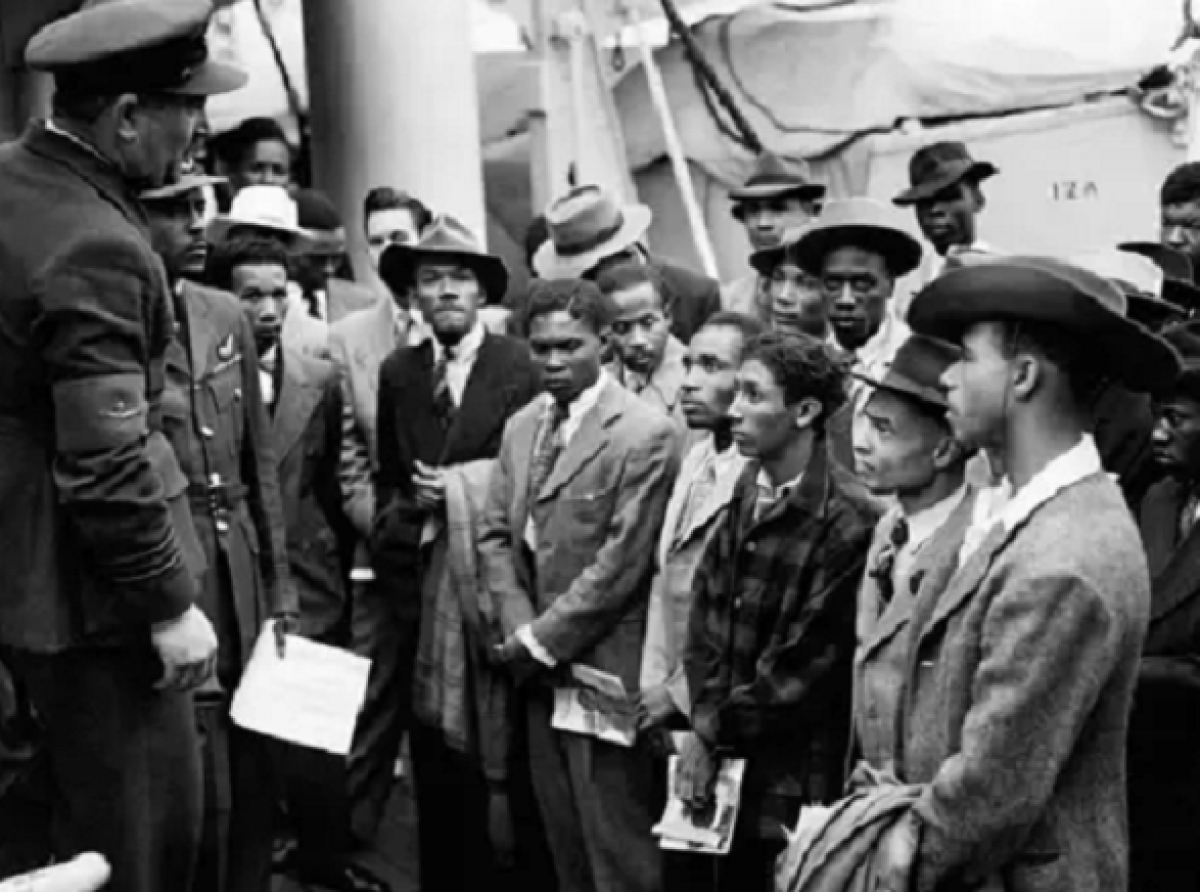
As the UK’s Black History Month is in full swing, it’s worth remembering that the majority of the Windrush generation did not necessarily come from the Caribbean, but the label has left those from other parts of the Commonwealth unaware of their rights to restitution after years of mistreatment.
Chris Hayibor was only two when he came to England from Ghana with his family in the early 1970s and settled in a multicultural pocket of north-west London. Like many families arriving from the Commonwealth in the decades after the Second World War, they had indefinite leave to remain (ILR). Britain is all he has ever known.
His troubles began 20 years ago when he was working as a bus driver and had to show his passport, birth certificate and driving license as part of a routine check. After producing the documents, he left them in his car and went back to work. Then came some bad luck. “A string of cars had been broken into,” he says.
“They took everything.” The theft proved disastrous. To get a new driving licence he needed a passport, and to get a passport he needed a new birth certificate – which the Ghanaian government requires applicants to collect in person.
Unable to leave the country without a passport, Hayibor was left without any form of identification. “I was stuck in a very bad situation,” he says. He navigated life as best as he could, jumping between different jobs.
But everything changed in 2012 when the government introduced policies known collectively as the “hostile environment”, which made life harder for immigrants without paperwork. “We have to prove you have the right to work here,” was the constant refrain from Hayibor’s boss.
Hayibor says he felt compelled to resign from a job as a carer and has struggled to find work ever since. “My life just stopped,” he recalls.
“I was in such a dark place I went to the chemist and asked, ‘If I bought a packet of Anadin and a bottle of vodka… Is that enough for me to take my own life?’” People from the Windrush generation – who arrived in Britain between the late 1940s and early 1970s but didn’t have documentation to prove their right to be here – were being harmed by the hostile environment, and Hayibor was among those caught up in what came to be known as the Windrush scandal.
But when the scandal was uncovered, Hayibor assumed it had nothing to do with him. “The way they made it sound, it was as if it was only about the Caribbean.” Hayibor’s story illustrates an under-examined aspect of the scandal: many people of south Asian or African descent, have struggled to get the recognition or help they need.
At the time of the 2011 census, almost 600,000 people from the Commonwealth who arrived before 1971 were living in Britain. Of these, however, the vast majority – more than 450,000 – came from non-Caribbean countries. Yet Caribbean nationals account for the majority of claims under the Windrush compensation scheme, which was set up in 2019.
Between then and July 2026, there were 761 claims from people of Caribbean descent compared with 577 from the rest of the Commonwealth. Campaigners say this disparity is partly the result of the decision to name the scandal and scheme after the ship that brought one of the first large groups of people to Britain from the Caribbean in 1948. Those affected say there are also cultural and economic factors at play that mean people who arrived from other parts of the Commonwealth are less likely to have been victims of the scandal.
Others believe that institutional bias, particularly against those who came to Britain from west Africa, has caused families to slip through the cracks. Neil Mukherjee was born in Huddersfield in the early 1970s to parents of Indian heritage. He said many south Asian victims have not come forward because they do not want to cause trouble.
“Many south Asian people who have been impacted are afraid of the British system… they just don’t want to rock the boat,” he says. Mukherjee’s family fell foul of what some lawyers call the “Windrush trap”. Their indefinite leave to remain lapsed during a brief trip to India and Mukherjee’s mother and brother, who were born there, got stuck in “no man’s land” and were prevented from returning to Britain.
After decades of fighting, Mukherjee’s brother regained his right to live in Britain in 2002. His mother did the same in 2024, after applying to the Windrush scheme, which the government set up in 2018 to help people with the right to be in Britain obtain documentation proving it. Mukherjee said he believed the “Windrush” branding explained the smaller number of non-Caribbean claims. “It wasn’t promoted and packaged as a Commonwealth scandal,” Mukherjee says.
The term “Windrush generation” was coined by British-Jamaican activist Sam King to describe the 1948 arrivals on the HMT Empire Windrush but over time it has become more flexible, and is now regularly used to refer to people who came from the Caribbean throughout the post-war era. The ministry of housing, which allocates funding for organisations wishing to celebrate the Windrush generation, defines it as exclusively Caribbean. But the Home Office’s definition is more expansive than many inside and outside of government realise, describing the generation as including all arrivals from the Commonwealth during the post-war period up to the early 1970s.
Jacqueline McKenzie, a leading immigration lawyer who was at one stage approached to become the government’s Windrush commissioner, said it is known that the terminology is potentially confusing. “Every home secretary or senior permanent secretary blames the previous one […] for calling it ‘the Windrush’,” she says.
“They say, ‘We need to do something about that because everybody thinks of that boat and they think of not even just the Caribbean but Jamaica’… But the Windrush generation does actually include west Africans and south Asians.” The Home Office has quietly renamed the Windrush taskforce, which supports people with Windrush scheme applications, as the Commonwealth taskforce.
McKenzie says she was also told of plans to replace the word “Windrush” with “Commonwealth” in the names of the two schemes set up to help victims of the scandal, but they have yet to materialise. The number of people who have potentially fallen through the cracks is not clear, but could be large. In 2019 Meg Hillier, then chair of the government’s public accounts committee, raised a concern with the Home Office that about 160,000 non-Caribbean Commonwealth nationals may be missing out on support.
There are also concerns the government is doing too little to help those affected. An independent review in 2020 advised the Home Office to “look beyond the Caribbean” and “be more proactive in identifying people affected,” but in 2022, an independent progress evaluation found the recommendation had only been partially met. A Home Office spokesperson said: “The Home Secretary is determined to put right the appalling injustices caused by the Windrush scandal, making sure those affected receive justice and the compensation they rightly deserve.
“We are actively raising awareness of the Windrush compensation scheme among African, South Asian and other non-Caribbean communities.” Emmanuel Ani came to England in 1972 at the age of seven, travelling under his mother’s passport. When he was 15, his parents took him back to Nigeria for what he thought was a holiday.
He ended up stuck there. “My first few years were hell,” he says in an accent that hints at his British upbringing. “I found it really hard, culturally and environmentally – it was suffocating.”
As soon as he reached adulthood, Ani says he made multiple attempts to return to Britain but was stonewalled by high commission staff in Abuja and Lagos. He only applied to the Windrush scheme because a British cousin told him about it – news of the scandal hadn’t reached him all the way in Enugu State. He has since applied for a returning resident visa under the Windrush scheme and been rejected.
Both of his parents were British, as are five of his siblings. But although England no longer feels like home to Ani, now in his 60s, the principle remains important. “I want my rights. [A visa] is not a privilege, it’s my right.”
Ani’s family say cases of people stuck for decades in the Caribbean who have since been granted returning resident visas through the Windrush scheme are evidence that Ani and other Nigerians are being treated unfairly. When The Observer asked the Home Office, via a freedom of information request, for a breakdown of the number of Windrush scheme applications by country of nationality, it said “the cost of locating and collating any relevant information and extracting the information” would be too great. Nigerians and Ghanaians seem to be getting a harder time,” McKenzie says.
“Is it because the discrimination towards them is different, or simply because the Home Office thinks the numbers of eligible applicants could be huge?” Roland Houslin, founder of campaign group Justice for Windrush Generations, says: “There is a definite bias against west Africans in general… There is an assumption that applications are fraudulent.”
But others warn that talk of anti-west African bias risks playing into divide-and-rule politics. “Every person engaged in the Windrush scheme is being treated detrimentally,” says Pauline Campbell, a lawyer who works with charity Justice 4 Windrush and is helping Hayibor fight the Home Office for citizenship. “If we say they are biased towards Jamaicans, that makes it look as if Jamaicans are getting a better deal,” she says.
“No one is getting a good deal.” Significant hurdles remain for those applying to the compensation scheme. The majority – 66% – of applicants are unsuccessful or receive nothing, and those living abroad face acute challenges.
Unlike most, Hayibor has received compensation – and is now arguing for more to better reflect his many years of suffering. But he has repeatedly been denied citizenship. His latest rejection came days before he received an invitation to this year’s Windrush Day celebrations at Downing Street. But Hayibor has reason to be optimistic.
He has used the universal credit support he now receives to pay for a bus driver training course, was able to persuade TFL to consider an application and late last month was offered a job as a driver. He cannot wait to get back behind the wheel. “The day I get back on the bus, I’m taking everybody out for a meal,” he says.
“I’ve got so much to look forward to… I didn’t have anyone helping me but now I do. And that’s given me a chance.”